From Startup to Enterprise – Which ERP Truly Works for You?
A Comprehensive Comparison between Odoo and SAP
When evaluating enterprise resource planning (ERP) systems, businesses often find themselves choosing between two of the most prominent solutions in the market: Odoo and SAP. Both platforms offer comprehensive functionality across various business areas, including Human Resources (HR), Manufacturing Resource Planning (MRP), and Point of Sale (POS). However, the way each system handles these modules can differ significantly, especially when considering factors such as cost, ease of use, scalability, and implementation time.
In this comparison, we focus on three key modules: HR, MRP, and POS. These modules are vital for managing employees, streamlining manufacturing processes, and handling retail operations, respectively. By examining these modules, we highlight the strengths of Odoo over SAP in terms of cost-effectiveness, user-friendliness, flexibility, and the speed of deployment. This comparison will help organizations make an informed decision based on their specific needs and business size, ultimately guiding them toward the ERP solution that best suits their goals.

Compare the implementation time and ease of setup between Odoo and SAP

Evaluate customization options and their complexity

Examine integration capabilities, reporting, and analytics features

Highlight the cost differences and affordability for various business sizes

Analyze user interface design and user experience

Review core module functionalities like HR, MRP, POS, and deployment flexibility
What is Odoo?
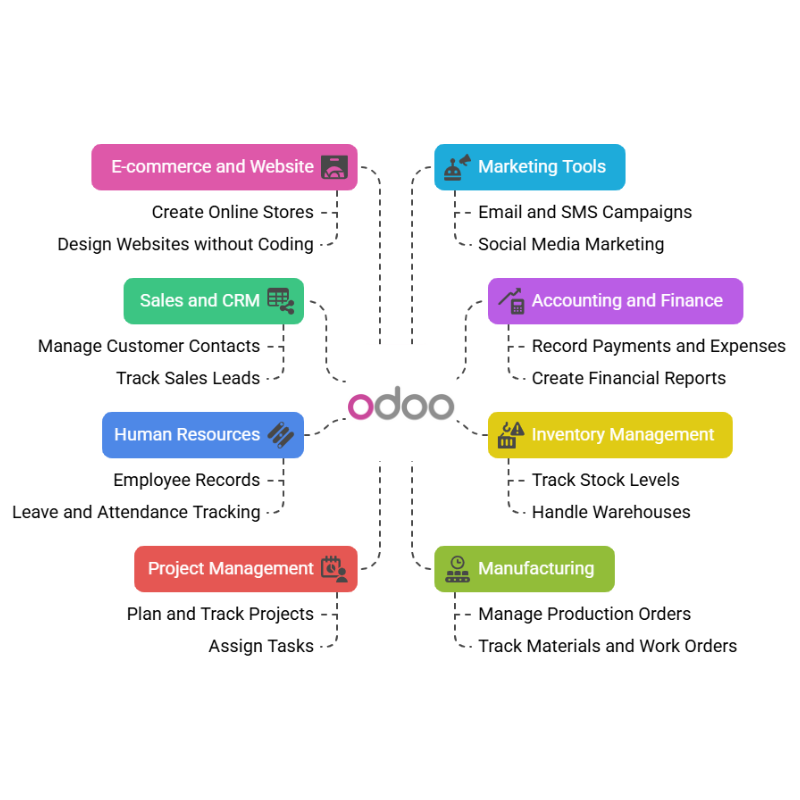
Odoo is a business management software that helps companies run their daily tasks in one place. It is known as an ERP (Enterprise Resource Planning) system. This means it brings together different parts of a business—like sales, accounting, inventory, and more—into one easy-to-use system.
Odoo is used by many businesses around the world because it is flexible, affordable, and can be used by small, medium, or large companies. It is available in two main versions:
Odoo Community (free and open-source)
Odoo Enterprise (paid, with more features and support)
What is SAP Business One?
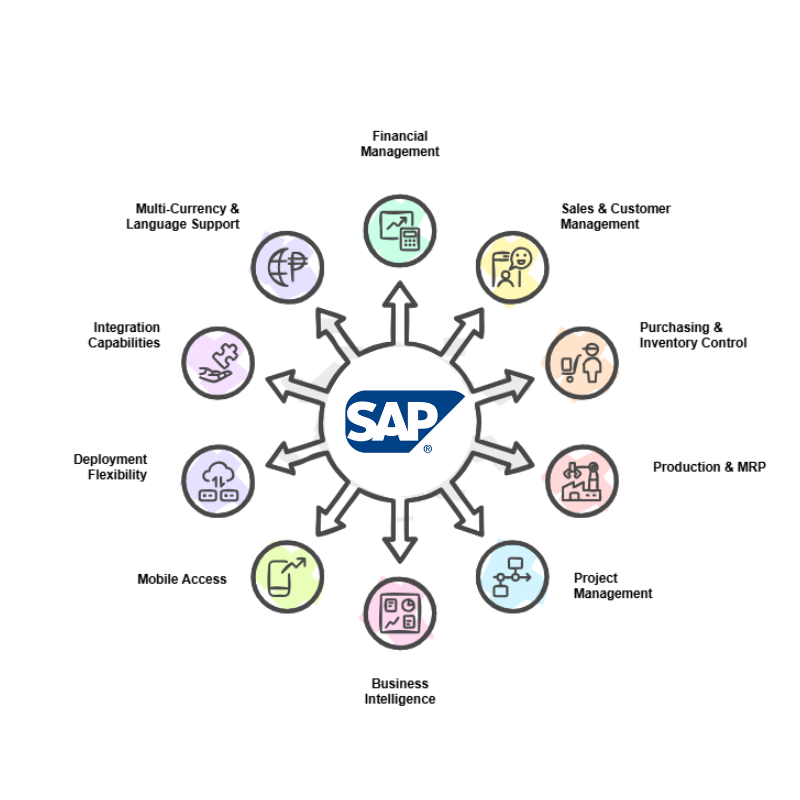
SAP Business One is an affordable ERP solution from SAP, tailored for small to mid-sized businesses. Introduced in 2002, it supports essential business functions such as finance, sales, customer relationship management, inventory, and basic manufacturing. Designed for fast implementation with minimal customization, it offers deployment flexibility—either on-premises or in the cloud. Business One is well-suited for companies involved in light manufacturing but may require additional modules or custom development for advanced planning and detailed shop floor control. As SAP’s entry-level ERP offering, it enables growing businesses to manage operations efficiently while benefiting from SAP’s reputation for reliable enterprise software.
Odoo vs. SAP – Features Comparison
Features
Implementation Time
Odoo
Fast implementation with a user-friendly setup.
SAP Business One
Longer implementation, especially for large organizations.
Why It Matters
Faster setup means businesses can start operations quickly, reducing downtime and cost.
Cost
More affordable, especially for smaller businesses.
High implementation and licensing costs.
Cost affects accessibility; lower costs help SMEs adopt ERP systems easily.
Customization
Highly customizable with an open-source model.
Customizations can be expensive and complex.
Customization allows the ERP to fit specific business needs and workflows.
User Interface (UI)
Modern, intuitive, and user-friendly interface.
SAP has improved but still complex for some users.
A simple UI improves user adoption and reduces training time.
Integration Capabilities
Seamless integration with other Odoo
modules.
SAP requires third-party middleware for integrations.
Smooth integration enhances efficiency and minimizes data silos.
Reporting & Analytics
Real-time, easy-to-understand reporting.
Complex, often requiring additional modules.
Real-time, simple reporting helps faster decision-making and transparency.
HR Module Features
Employee management, payroll, timesheets, recruitment.
HR features are comprehensive but expensive.
Having built-in HR features streamlines internal operations and saves on additional software.
HR User Experience
Simple and easy-to-navigate HR interface.
SAP's HR module can be complex and less intuitive.
Easier HR interface increases productivity and reduces errors.
MRP Module Flexibility
Highly flexible with easy integration into sales and inventory.
More rigid; complex to adjust based on specific needs.
Flexibility in MRP helps manufacturers adapt quickly to changes.
MRP Implementation
Quick to implement for small and mid-sized manufacturers.
MRP implementation in SAP can be time-consuming.
Faster implementation means quicker return on investment.
POS System Simplicity
User-friendly POS system, ideal for SMBs.
SAP POS requires heavy configuration and high investment.
Simpler POS systems enhance customer service and ease of use for staff.
POS Flexibility
Highly adaptable, allowing businesses to set up according to their needs.
SAP POS is often rigid and requires more expertise to tailor.
Flexibility in POS helps businesses handle various sales models effectively
Multi-Company Support
Works well for multi-company setups in Odoo Enterprise.
Multi-company support is complex and costly.
Good multi-company support enables efficient centralized management.
Cloud Deployment
Flexible cloud and on-premise deployment.
Primarily focused on on-premise or complex cloud solutions.
Cloud flexibility allows businesses to scale and operate remotely with ease.
Open-Source Advantage
Fully open-source with a large developer community.
SAP is closed-source, making it difficult to modify without expert support.
Open-source systems offer transparency, community support, and faster innovation.
Why Odoo is Better than SAP?

Lower Cost
Odoo’s Community version is completely free, and its Enterprise version is much more affordable than SAP. SAP involves high costs for licenses, maintenance, and implementation. For small and medium businesses with limited budgets, Odoo offers a cost-effective alternative without sacrificing essential ERP features.

Faster Setup
Odoo can be implemented quickly—often within weeks—thanks to its modular structure and ease of use. This is ideal for growing businesses that need a rapid solution. SAP, on the other hand, requires months of planning and a large team to handle configuration and deployment.

Easier Customization
Odoo is open-source, which means developers can modify the code to add or change features as needed. This makes it highly adaptable for different industries. In contrast, SAP is a closed system, requiring costly consultants and long approval processes for even small customizations, limiting flexibility.

All-in-One Platform
Odoo integrates various business tools—ERP, CRM, website builder, eCommerce, accounting, POS, and more—within one platform. This eliminates the need for third-party apps. SAP focuses mainly on core ERP functions and often requires external systems to match the variety of features Odoo includes by default.
Our Next Comparison Page